

The U.S. real estate market is both vast and diverse, and it continues to evolve.
While the forces shaping the real estate sector may seem more complex than ever, the principles underpinning real estate investment remain intact. However, not all sectors face the same risks and opportunities.
From residential housing to industrial warehouses, and from small local landlords to major institutional investors, the sector spans opportunities and risks. In this article, we shed light on the most important trends, from shifting demographics and regional differences to capital flows and the evolving risks of development.
The Many Facets of Real Estate
It is difficult to make sweeping generalizations about real estate, as it isn’t a homogeneous market but rather a collection of asset classes that behave differently and asynchronously. Traditionally, the main categories include residential properties, industrial buildings, retail centers, and office buildings. Beyond these, niche segments such as hotels, senior living facilities, self-storage units, mobile home parks, and cold-storage warehouses are playing increasingly important roles.
National Property Types: US National Indices
Source: MSCI, RCA CPPI US, as of 31 December 2025.
Some active investors take a generalist approach to real estate investment by comparing opportunities across asset classes to find the best relative value. Market conditions vary not only by property type but also by geography. For example, two buildings on the same street can perform very differently due to small differences in location, tenant mix, or local economic activity.
For decades, the U.S. real estate world was divided into gateway markets (the largest U.S. metropolitan areas like New York and Los Angeles), secondary markets (dominant regional cities like Boston or Miami), and tertiary markets encompassing everything else. But that dated map has started to blur. Economic growth in places such as Dallas–Fort Worth has pushed these markets into the top tier by transaction volume, population growth, and investor interest.
More broadly, the so-called Sun Belt—stretching across the South from Florida to California—has seen booming demand for both housing and commercial properties. Job growth, lower taxes, lifestyle preferences, and warmer weather have helped fuel that rise.
Still, it’s difficult to oversimplify. Real estate is ultimately local, with each region’s supply, demand, regulatory environment, and employment base shaping how markets behave. For example, state capitals may have more stable office demand due to government tenants, while auto manufacturing hubs like Detroit or South Carolina can see performance tied closely to factory output and consumer demand for vehicles.
Macro Trends Reshaping the Landscape
Several long-running social and economic trends continue to influence real estate:
1. Demographics
The aging of the Baby Boomers has long been a central theme. But younger buyers now face affordability challenges, with the average first-time homebuyer nearly 40 years old. As older homeowners downsize, more housing could eventually become available to the next generation—though this adjustment is slow. The combination of these trends in certain markets can indicate an evolving need in existing housing inventory.
U.S. Population by Age Group
Source: U.S Census Bureau
2. Office Usage
The pandemic accelerated the shift toward remote and hybrid work. While many companies are bringing employees back to the office, the purpose and usage of office space have changed. This is not necessarily a new trend, but an acceleration of a trend that developed throughout the 2010s. Some properties, especially older or poorly located ones, are now considered obsolete unless they undergo extensive renovations or even full conversions.
3. Supply Chain and Industrial Demand
E-commerce continues to boost demand for warehouses and logistics centers. At the same time, efforts to encourage domestic manufacturing and nearshoring are creating pockets of industrial development tied to rail networks, trucking hubs, and specialized production facilities. This is driving demand growth for the development of new warehousing and manufacturing facilities, and in many markets, supply remains insufficient to meet demand.
The Real Challenges of Development
Developing new real estate is capital-intensive, requires a multi-year investment horizon, and faces significant risk throughout the development process. Developers must navigate local approvals, rising labor costs, and fluctuations in material prices. Tariffs on imported goods have added further cost pressures. In some high-growth cities, such as Denver, Phoenix, Austin, and Nashville, construction in recent years has outpaced demand growth, leading to a temporary mismatch between new supply and tenant demand, pushing down occupancy rates and slowing rent growth.
These hurdles mean fewer new projects are breaking ground today. As a result, many investors expect that once the current wave of new buildings is absorbed, rent growth could accelerate again, but opinions differ on the timing.
Who’s Buying and Why It Matters
The market’s capital sources are shifting. Large institutions, including pension funds, insurance companies, and sovereign wealth funds, still play a major role, but private equity firms and real estate-focused investment funds have grown rapidly. More recently, retail investors have gained access to private real estate offerings that were once reserved for institutions.
Smaller Buyers Taking Market Share as REITs Pull Back
Investor Allocation by Property and Investor Types
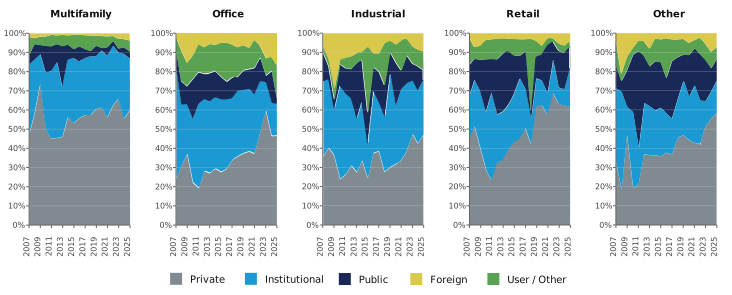
Source: Real Capital Analytics, Newark Research, as of 14 October 2025. Other includes hotel development sites, senior housing and nursing care, self-storage, parking, and manufactured housing.
Interestingly, despite consolidation trends across most industries, smaller players, consisting of local landlords and entrepreneurial investors, still have opportunities. Large funds often need to deploy capital in large chunks, leaving many mid-sized deals to smaller, more flexible buyers.
How Deals Are Structured
Most real estate transactions rely on a blend of debt and equity. A typical project might use 50–65% leverage (in the form of a senior loan) and cover the rest with equity from developers or investment partners. But as interest rates have risen and equity returns have become less attractive, sponsors are increasingly looking to mezzanine debt and preferred equity to fill gaps in the capital stack. These options offer investors returns in the mid-teens, which is similar to what common equity investors once earned.
Bridge loans, which provide short-term financing between construction and final stabilization or sale, have also become more popular. These come at a cost, often 200 or more basis points above traditional loans, reflecting higher risk.
The Link Between Interest Rates and Real Estate
Interest rates sit at the heart of nearly every discussion about today’s real estate market. Because most properties require financing, the cost of borrowing directly affects valuations. While interest rates have risen sharply in recent years, cap rates—the yields buyers require on properties—haven’t increased as much as expected. This mismatch has contributed to a slowdown in transaction activity, as sellers hold onto properties rather than accepting lower prices.
Investment Sales Volume
Source: Real Capital Analytics, Newark Research, as of 14 October 2025.
The resulting bid-ask spread is one of the biggest barriers to deal-making today. Sellers believe values will rebound, but buyers want prices that reflect higher financing costs. Until interest rates fall or economic confidence improves, this standoff may continue.
AI, Data Centers, and the New Digital Real Estate
One of the biggest capital investment stories is the explosive growth of AI and data centers. These facilities require substantial power, specialized infrastructure, and strategically located land. While this boom hasn’t yet drained capital away from traditional real estate sectors, it has opened new opportunities, especially for landowners who can secure sites with the right utility and power access.
What’s Next?
Despite the complexity of today’s environment, real estate remains rooted in a few durable principles: the importance of location, the value of local expertise, and the fundamental balance between supply and demand. The next few years may see slower rent growth in some markets, continued challenges for certain property types, and a gradual resolution of the bid-ask impasse that has stalled deal flow.
But with population shifts, technological expansion, and evolving economic conditions, real estate continues to offer diverse opportunities for investors who understand the landscape and who are prepared to adapt to changing market conditions.
Discover more about:
Related Content
More Insights

Uncertainty is High, the Margin for Error Isn’t
Navigating Supply, Rates, and Opportunities in Real Estate

With Intelligence Honors Thornburg with Two 2026 Mutual Fund & ETF Awards

Structural Forces Are Reshaping the Investment Landscape

A Disciplined Approach to Global Equity Income