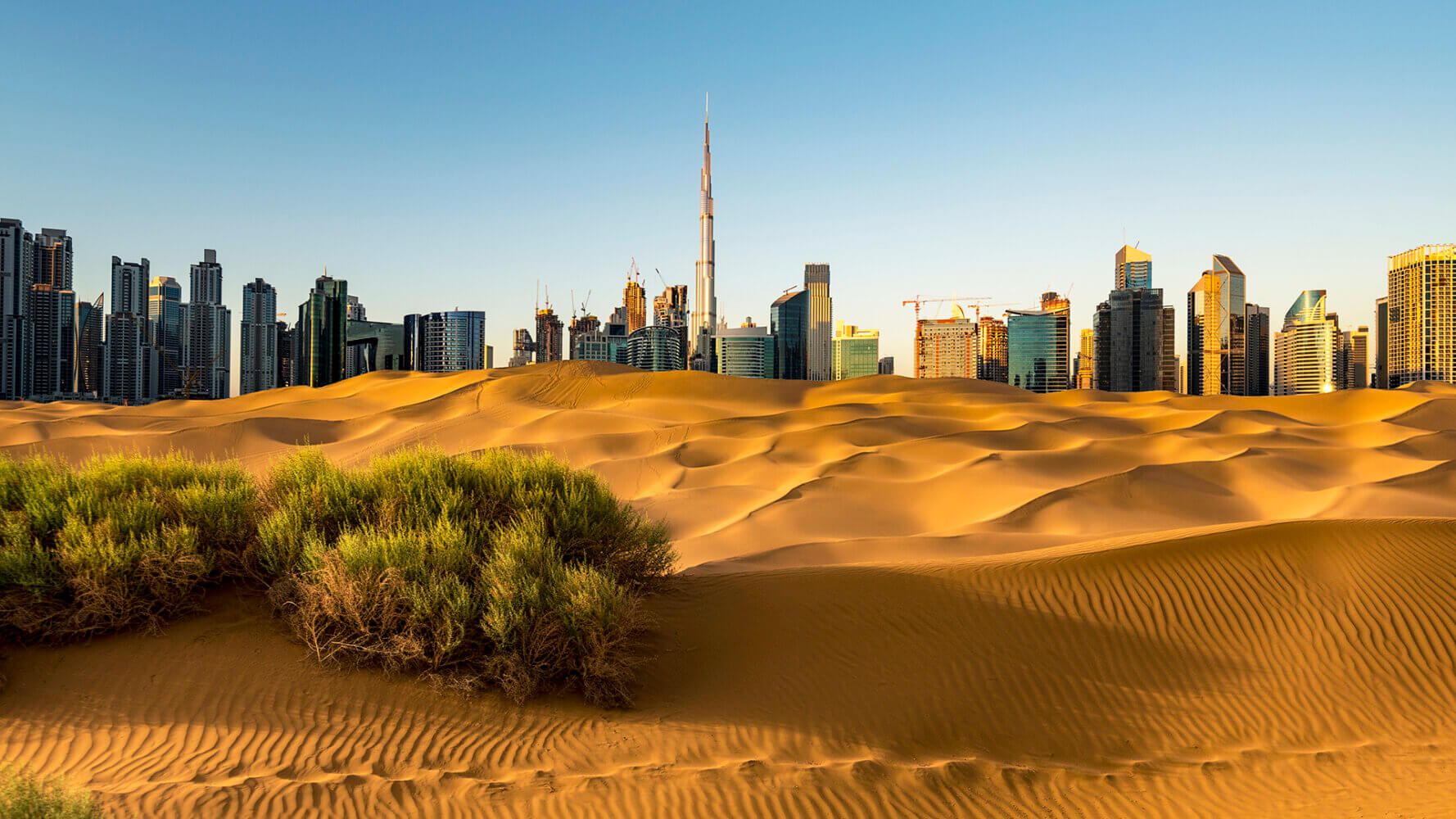

Our investment professionals travel the world to evaluate global markets and unearth the most optimal ideas. Josh Rubin recently visited the United Arab Emirates (UAE), and here are his perspectives.
While the nightly news tends to focus on the changing US-China relationship or the Russia-Ukraine war, opportunities in the broader EMEA region (Europe, the Middle East, and Africa) are often underappreciated. Following Russia’s removal from global equity indices, the largest components of EMEA are now the major economies in the Middle East. The focus of my trip was on the second-largest economy, the United Arab Emirates (UAE). This country is a federation of seven separate but integrated emirates. Abu Dhabi is the economic and politically dominant emirate, with His Highness Sheikh Mohamed Bin Zayed also serving as the President of the UAE.
With over 3 million barrels per day of oil production (and a goal to increase production capacity to 5 million barrels per day by 2027) against a population of less than 11 million people, it’s easy to think of the UAE as being just about oil. But in spite of volatile oil prices and global and regional geopolitical upheaval, many UAE stocks have produced steady returns over the last several years due to the impressively diversified local economy.
The UAE is Firing on All Cylinders as an Oasis of Stability
The government’s budget is less dependent on oil revenue (or higher oil prices) compared to regional peers.
Oil Price Strength Bolsters Fiscal Balances
Source: IMF, IIF, FAB. Latest oil price break-even from the IMF 2025 forecasts.*Represents the break-even price in USD of brent per barrel.
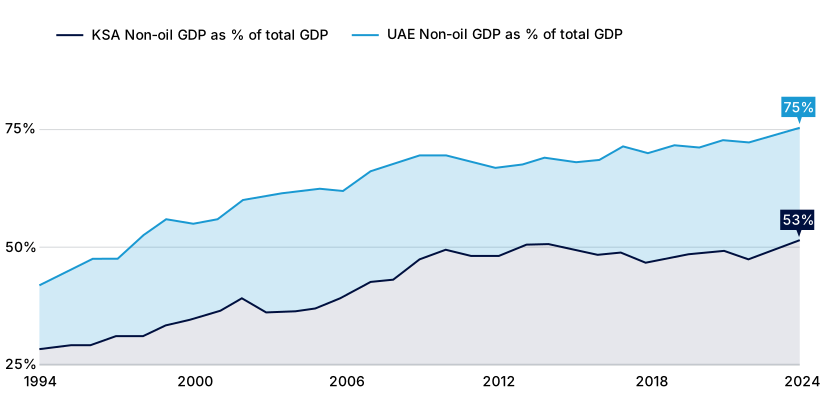
The UAE’s economy is about 75% non-oil, while Saudi Arabia is about a 50/50 split between oil and other contributions to GDP. With Saudi Arabia as the biggest oil producer and largest economy in the region, investors have overlooked some of the more differentiated investment opportunities in the UAE.
UAE Non-Oil Contribution Reaching New Highs
Source: National Accounts
Housing Market
There is a housing and population boom in the UAE as a global population moves to the country for multiple reasons. The burgeoning white collar job market in financial services and technology is drawing a primarily European and Asian educated workforce. Retirees are moving to take advantage of pleasant weather (7-8 months of the year), where the cost of living is lower than in southern Europe. Despite the various elements of regional unrest over the last 20 years, the UAE has been an oasis of stability, similar to Singapore, attracting entrepreneurs from other Arab countries. And several emirates continue to develop industrial hubs and tourism. As an overly simplistic analogy, Dubai is developing like Miami, and Abu Dhabi’s growth profile is more similar to Houston, while the other emirates each fit somewhere in between.
Residential Property Prices Have Experienced Significant Growth
Source: REIDEN data analytics’ United Arab Emirates Property Price Report, March 2025.
The Golden Visa Motivates Families to Move
One of the substantive changes in the UAE has been the 10-year golden visa. Prior to COVID, people had to get their work visa renewed every two or three years, so they didn’t want to commit to Dubai or Abu Dhabi. Consequently, workers had a short-term mindset and left their families behind. However, with a 10-year work visa, they are now willing to move their families and put down roots.
One of the big proof points for the durability of the UAE’s growth is the visible growth of private school enrollments. People are leaning into building a life in the country by moving their entire family, which is the clearest sign of durable residential activity rather than just relying on speculative participation in the housing market.
Source: Emirates NDB.
And that commitment drives investment and consumption, which we can track in related data such as toll road traffic volume.
Source: Net toll traffic: total trips through Salik gates, excluding discounted trips (taxis without passengers, Al Mamzar and Al Maktoum gates free time and discounts, vehicles exempted by law, and multiple violations).
Liquidity and Growth
The UAE and the Kingdom of Saudi Arabia (KSA) both have significant investment ambitions. Both are building significant civil infrastructure, tourism districts, and expanding their hydrocarbon production and processing capabilities. But over the last five years, on a relative basis, there has been less foreign direct investment into Saudi Arabia than into the UAE. Consequently, Saudi banks are funding most of the local investment with domestic deposits, while new UAE capital expenditures have been funded with a healthy mix of foreign capital.
Without meaningful foreign investment, a stimulative investment program requires sufficient banking sector liquidity. Because Saudi Arabia’s grand ambitions are being funded primarily from domestic savings, liquidity has been tightening over the last several years. Given the higher mix of foreign flows into the UAE, the banking system has surplus liquidity that supports capital expenditures, capital markets, and consumer and corporate confidence. Conversely, the KSA’s banking system liquidity has tightened over the last several years as the capital expenditure cycle ramped up.
An indication of these dynamics can be seen in the following chart, which tracks loan-to-deposit ratios for comparable large banks in the UAE and the KSA. Saudi National Bank and Emirates NBD (in the UAE) are more traditional commercial banks, and Al Rajhi (in the KSA) and Abu Dhabi Islamic Bank follow Shariah banking principles. The trend for both types of banks is clear in each country; there are excess deposits in the UAE but not in the KSA (where it was previously a healthy sub-90%, but is now above 110%). The tighter liquidity in Saudi Arabia has knock-on implications for local monetary policy and consumer spending compared to the UAE or other regional economies. It will take a combination of U.S. Fed rate cuts and KSA monetary authority adjustments to improve the situation in Saudi Arabia.
Loan-to-Deposit Ratio
Source: Bloomberg
Key Takeaways
The UAE is an impressively diverse economy that seems to be firing on all cylinders as an oasis of stability, and with limited sensitivity to global oil dynamics. Although an emerging market exporter (of oil), it has negligible exposure to U.S. tariff uncertainties, and a wide variety of industries drive 75% of its GDP. There is even diversity of development between different emirates, with Dubai’s evolution resembling Miami, and Abu Dhabi more similar to Houston. Workers are committing to building a life in the UAE, and a less transient workforce creates more durable consumption patterns and a healthier property market. New residents are bringing their wealth with them, and foreign capital is excited to invest in the UAE, creating a healthy funding environment for infrastructure to be built and businesses to expand.
Discover more about:

More Insights
Opportunities in Overseas Equities

Quality Without Dogma: Why Valuation Still Matters

What Tight Credit Spreads Mean for Investors

Signal Over Noise: A Conversation on Global Markets

VettaFi Webcast: The Rise of International Equities