

Private credit’s growth to $2T brings new risks. Learn where to find better risk adjusted returns—and how to navigate cov-lite, redemption pressure, and mega fund concentration.
It’s Time to Talk Private Credit
Over the past decade, the term “private credit” has invaded the zeitgeist of investment strategies. Portfolio construction largely only accounted for private equity, private real estate and hedge funds as alternatives until the emergence of private credit. However, the rise in private credit as a desirable and potentially core allocation within every investor’s portfolio is undeniable. Moody’s recently published a report estimating that by the end of 2026 the private credit market will grow to $2 trillion and further estimates a doubling to $4 trillion by the end of 20301. To put that in perspective, the same report indicated that, as of 2014, the market was less than $500 billion and was mainly the domain of large institutional investors. In this brief article, we highlight the catalysts that contributed to the rise of private credit, and delve into the nuanced details of different strategies and how allocators are viewing portfolio construction in 2026.
Why Private Credit Became Ubiquitous
The rise of private credit stems primarily from post-2008 Great Financial Crisis banking regulations imposed on bank lending. Dodd-Frank and Basel III capital requirements forced banks to retreat from middle-market lending, creating a vacuum that direct lenders eagerly filled. Increases in regulation, paired with the ensuing low-interest-rate environment and the rise in deal-making activity by private equity, which layered on debt from credit partners to fund equity investments and buyouts, led to a surge in demand for private credit. From the investor’s lens (i.e. allocators of capital to private credit funds), as rates rose post-COVID, floating-rate private credit became even more attractive: what once struggled to deliver high single-digit net returns suddenly offered 9-11% yields with seeming safety.
Product proliferation followed predictably. Semi-liquid structures (i.e. interval funds and Business Development Companies (“BDCs”)) flooded the wealth channel, making private credit accessible to accredited and qualified investors who previously couldn’t access institutional funds. Assets poured in. And this is where we believe the problems are becoming apparent.
Cracks in the Foundation
Supply-and-demand dynamics are generally inescapable in any market. When too many assets chase too few goods, prices rise. In the private credit space, this dynamic is emerging as capital has flooded the asset class. However, it has played out as too many investors chase a limited supply of loans, resulting in a degradation of underwriting standards to secure the requisite supply for the funds and strategies managers are marketing.
For example, very recently, a large private credit manager/fund marked down holdings by almost 20%, sending a clear signal: cracks in private credit are no longer theoretical. For an asset class that has ballooned over the last decade and become the core allocation for yield-seeking investors (perhaps with a mix of FOMO), this markdown represents the first major repricing event in a cycle defined by aggressive growth and loosening standards.
Advisors may need to have difficult conversations with clients about private credit allocations. However, savvy investors are still finding attractive opportunities with compelling yields. Where, you might ask? They are becoming increasingly selective in both their investments and their partners. Private credit isn’t going away, but the environment is becoming more challenging than it has been in recent years.
This most recent NAV markdown is not an isolated event; it’s a symptom of structural issues now surfacing in the upper end of the market and among mega-funds.
Redemption Pressure Is Building
Private credit portfolios are marked using a variety of methods or some combination of internal/external third parties. These marks held steady through 2023-2024 even as public credit spreads widened and leveraged loan prices declined. Recent forced markdowns, coupled with increased redemption requests, reveal what many have suspected: we’re starting to see cracks in the upper-middle-market, semi-liquid private credit funds.
The Financial Times reported rising redemption requests in mega-funds in the semi-liquid space in early 20262. This creates a dangerous dynamic given the fund structure: funds are liquid until they aren’t. When redemption requests spike, managers become forced sellers. They must liquidate positions—often the most liquid, highest-quality credits—at discounts to meet withdrawal queues. The remaining portfolio begins to concentrate in harder-to-sell, lower-quality assets. That is, unless managers can rely on maturities, realizations, or recapitalizations to fulfill liquidity requests. This dynamic is very different from a traditional drawdown structure, in which managers raise initial capital, deploy it to a portfolio of loans, and pay back investors at the end of a defined period. Intermittent marks become less relevant, and the structure mitigates the risk of a forced sale or a “run-on-the-bank” event, because investors know they cannot access liquidity until the fund winds down.
The heightened demand for private credit, paired with the focus on creating core holdings for retail investors, led to the proliferation of semi-liquid funds, which in turn creates pressure on liquidity for an asset class that traditionally has not had to provide it.
Covenant-Lite Is Back
As competition for deals intensifies, credit protections erode. Covenant-lite structures—where lenders give up financial maintenance covenants and early warning signs—now dominate new issuance in the upper middle market and large cap space. Over 80% of new sponsored loans in 2024 were covenant-lite, compared to roughly 30% in 2013. This matters because when borrowers encounter trouble, lenders discover they have no ability to intervene until it’s too late. Recovery rates in covenant-lite defaults run 15-20 percentage points lower than traditional structures.
Leverage Has Crept Higher
Average debt-to-EBITDA multiples in sponsored buyouts (and those bringing a credit partner into an investment) reached 6.5x+ in 2024, well above historical norms. Combined with covenant-lite terms, this creates a potentially toxic mix: highly leveraged companies with no financial guardrails.
The Concentration Problem
The private credit market has become dangerously top-heavy. The chart below illustrates how the largest BDCs have captured a disproportionate share of asset growth:
Large BDC Growth Trend ($ Millions)
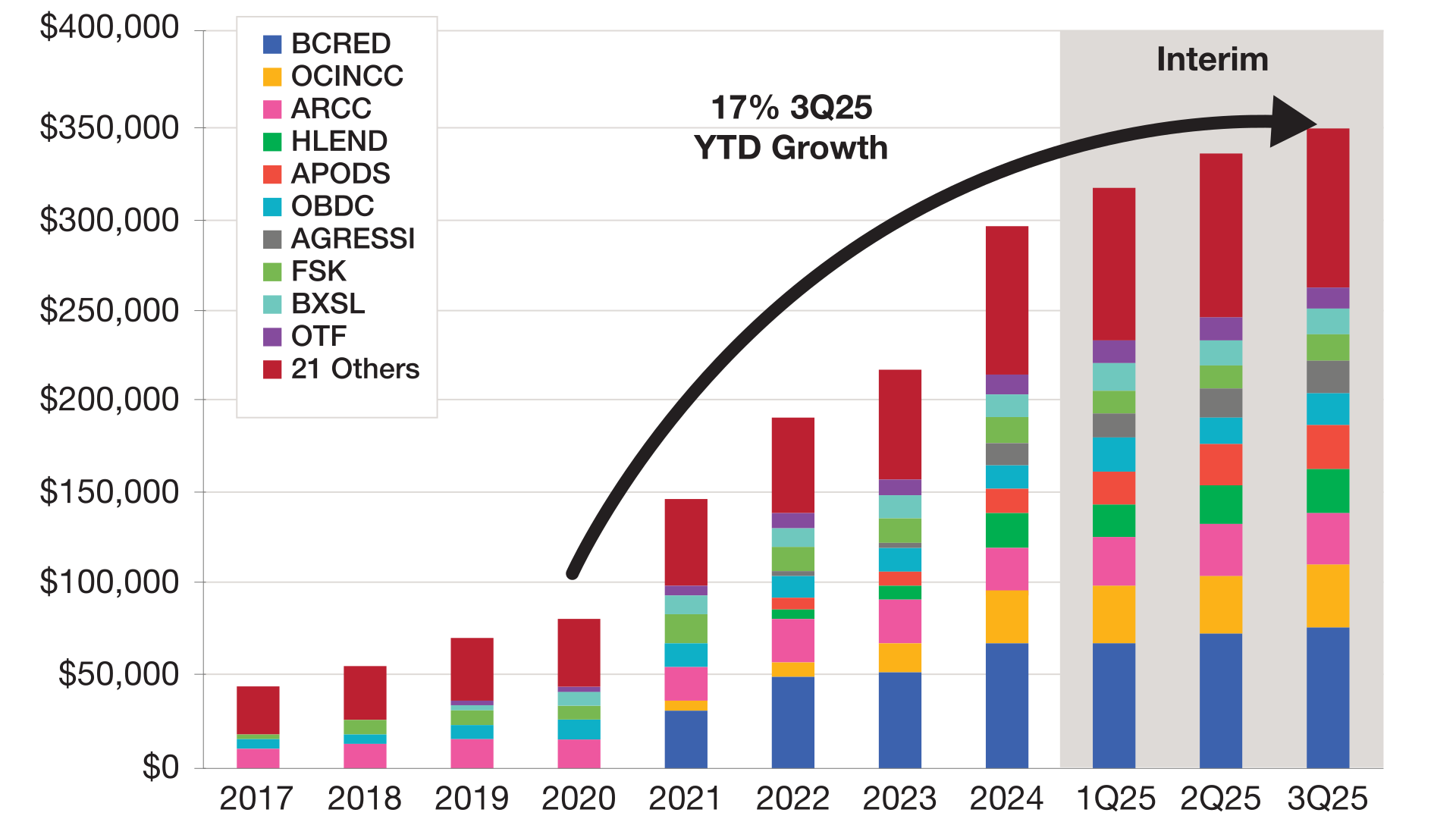
The top ten funds above have absorbed the majority of retail/private wealth flows. This creates an inescapable math problem.
When mega-funds compete for the same deals, one of three things happens: returns compress, risk increases, or both. These massive pools of capital are chasing a limited opportunity set in the upper-middle-market and large-cap spaces, precisely where covenant protections are weakest, and competition is fiercest.
The result? Investors are likely getting private credit beta, not alpha. A 300+ position portfolio across broad industries isn’t selective credit picking; it’s an index. And unlike public credit indices, this one comes with 20% annual liquidity at the fund/NAV level and valuations that may not reflect economic reality.
The Opportunity Set Mismatch
The disconnect becomes stark when examining the actual universe of borrowers:
Universe of Private Companies in the U.S. by Size
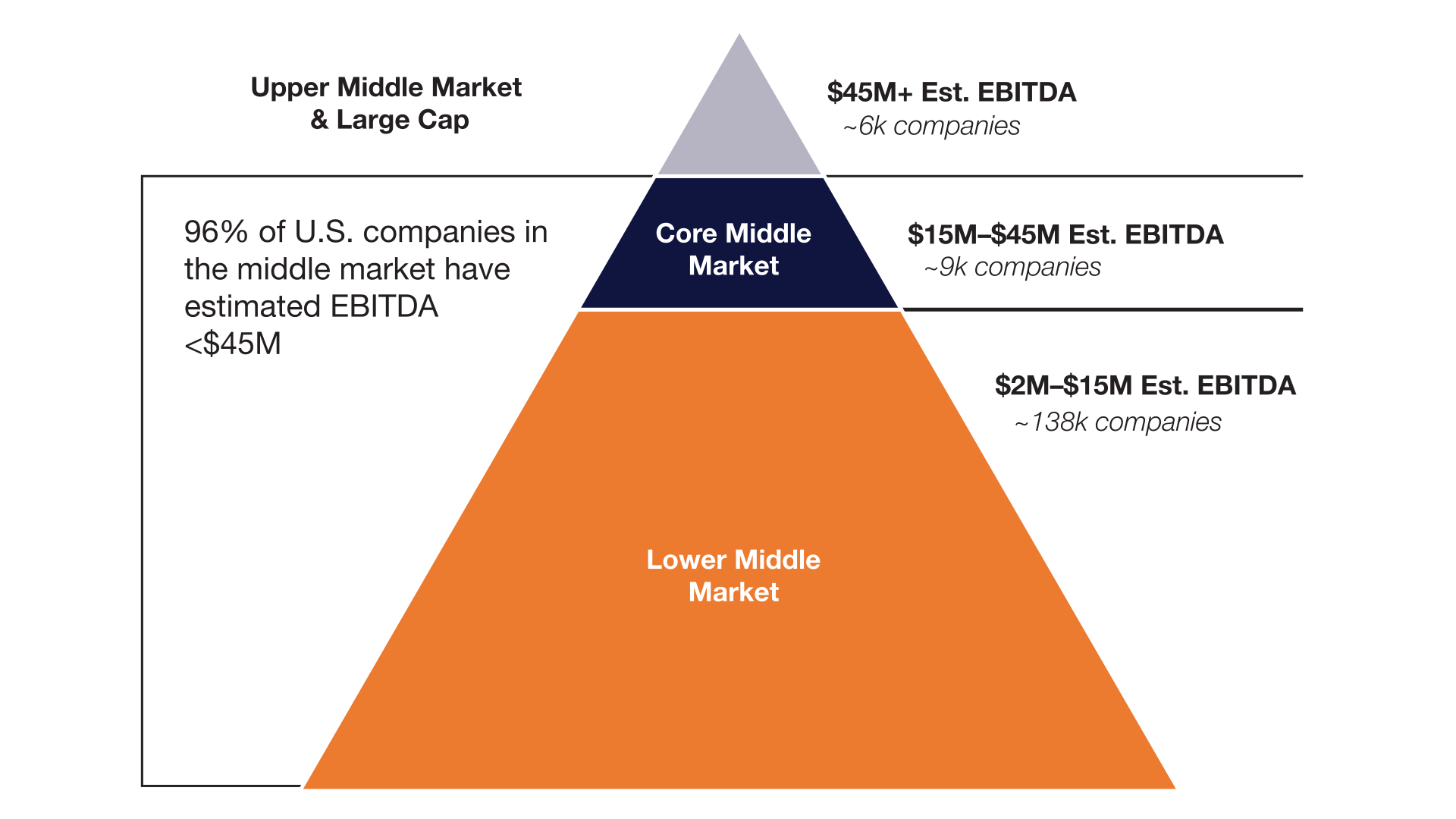
By company count, 96% of U.S. private companies fall into the lower middle market and middle market segments (sub-$45M EBITDA). Yet the mega-funds—constrained by their size—are most likely focused on the 6,000 companies representing 4% of the U.S. private market in the upper-middle-market & large-cap arena.
This decision is most likely a function of need rather than want. Think about the difficulty in deploying $50 billion into $5-15 million loan positions (e.g. a $25mm investment from a $5bn fund is a 50-basis point position. For a $50bn fund, that dwindles to a 5-basis point position). With that, oftentimes, the mega-funds are forced up-market into larger deals, where they face:
- Direct competition from banks and other large lenders
- Borrower-friendly terms and aggressive leverage
- Private equity sponsors with significant negotiating power
- Reduced yield for equivalent risk
Your clients’ capital is fishing in a crowded pond when an ocean of opportunity exists.
Where Should Advisors Look?
We believe private credit has a place in portfolios, but the landscape demands more careful navigation than it did 24 months ago.
Consider shifting exposures toward smaller, specialized managers focused on the lower middle market. These firms typically have structural advantages: less competition for deals, stronger negotiating positions with borrowers, and the ability to maintain traditional covenant packages and lower leverage multiples. They can be selective with 30-50 position portfolios rather than building 300+ name indices.
The trade-offs are real: reduced liquidity (in closed-end structures), operational complexity, and heightened manager-selection risk. But for investors planning to hold an investment for 5+ years, the risk-adjusted returns and credit protections in this part of the market may prove superior.
Action Items for Advisors
As investors look ahead within the private credit landscape, we suggest that advisors and their clients consider these steps:
- Scrutinize terms and structure. What are the actual redemption provisions? Quarterly with 90-day notice? What percentage of the fund can be redeemed per quarter before gates kick in (in the case of semi-liquid fund structures)? Has the manager ever gated redemptions? How much liquidity is inherently available in the strategy, without the need to force sell positions?
- Demand transparency. Ask managers directly about covenant packages in their portfolio. What percentage is covenant-lite? What’s the average leverage multiple?
- Diversify vintage years. This can be a difficult, yet critical component to a private credit allocation decision and any private market investment decision for that matter. Find managers that offer a fund that can achieve vintage year diversification with a single investment, i.e. something where instant vintage year diversification is feasible, yet be sure to consider the aforementioned fund structure and liquidity structure/requirements.
- Right-size allocations. If a concentration issue exists, look to pare back exposure and complement an already high-conviction manager that has perhaps raised significant assets (and is therefore potentially forcing style drift into their portfolio) with a manager focused on a different part of the market, with a competitive, repeatable process.
The most recent markdown witnessed this year, coupled with the increasing redemption requests seen by the semi-liquid fund structure managers, is a warning shot. The private credit market isn’t broken, but the easy ride is over. Your clients deserve portfolios positioned for a more challenging environment, not yesterday’s marketing pitch.
Discover more about:
Related Content

More Insights

Thornburg Investment Income Builder Fund – 1st Quarter Update 2026

A Disinflationary Paradox of High Oil Prices

Thornburg Income Builder Opportunities Trust Announces Distribution

Oil Shock Hits Different in a World of Shrinking Petrodollars
Thornburg Among First to Launch Actively Managed ETF Share Classes