

Exchange-traded funds (ETFs) enable investors to buy and sell a diversified portfolio of assets, such as stocks or bonds, offering low costs, transparency, and flexibility.
ETF Basics
ETFs are investment vehicles that provide efficient, transparent, and flexible exposure to a wide range of asset classes. Their structure and operations enable ETFs to develop three core characteristics, supported by a robust operational infrastructure and collaboration among key market participants.
Core Characteristics of ETFs
Three essential attributes define ETFs:
Valuation
ETF prices reflect the fair value of the underlying portfolio, taking into account operational costs.
Risk
The price movement of an ETF mirrors the risk profile of its underlying assets, ensuring alignment between the ETF and its portfolio.
Liquidity
ETF liquidity is derived from the liquidity of the underlying portfolio, enabling investors to enter and exit positions of any size with ease.
ETFs Combine Characteristics of Mutual Funds and Stocks
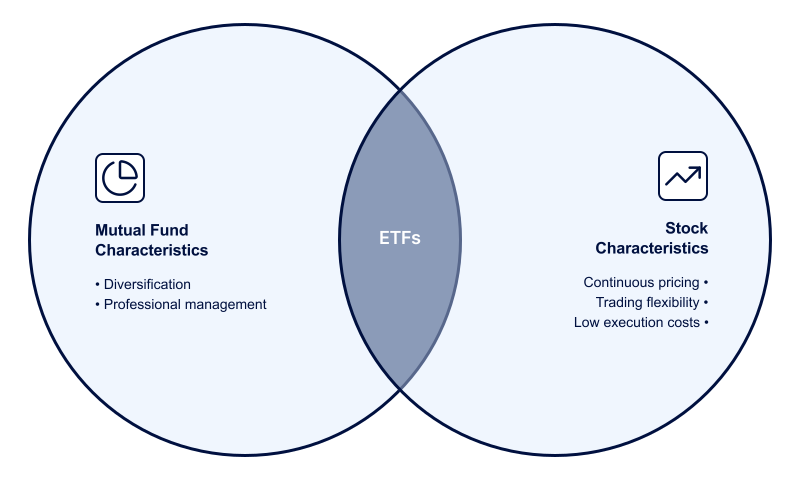
Comparing Mutual Funds to ETFs
| Mutual Fund | ETF | |
|---|---|---|
| Purchases and Redemptions | Purchased directly from mutual fund sponsor or broker acting on fund’s behalf | Investor purchases/sells shares in secondary market/exchange |
| Fee Structure | Itemized expenses with varying fees and share classes | Single fee includes management fee and fund expenses |
| Investor Trading | Trade at end-of-day closing price | Actively traded throughout the day at bid/ask market prices |
| Publication of Portfolio | Published monthly/quarterly on issuer’s website | Published daily on issuer’s website and the National Securities Clearing Corporation |
| Service Relationships | Custody, administration, retail TA | Custody, administration, TA/Order taker, authorized participants, lead market maker, listing exchange |
The Benefits of ETFs
ETFs offer several advantages to investors and market participants, including trading flexibility, transparency, tax efficiency, liquidity, and cost-effectiveness.
Trading Flexibility
& Transparency
Ease of trading is one reason why ETFs have been so widely embraced by investors.
Most ETFs disclose complete holdings daily.
Tax
Efficiency
ETFs are most often sold on securities exchanges from one investor to another in transactions that don’t require the sale of underlying securities. Secondary market transactions, coupled with the creation / redemption process, enable lower capital gains distributions and enhanced investor tax efficiency.
Lower
Operating Costs
Transfer agency costs are typically reduced with the ETF vehicle, though commissions and other brokerage costs remain.
Key Operational Features of ETFs
Transparency and Pricing
ETFs provide investors with clear visibility into both their holdings and pricing. This transparency enables more informed investment decisions by allowing investors to see exactly what assets are held within the fund and how those assets are valued.
In-Kind Delivery and Customization
The in-kind delivery process enables ETF issuers to tailor their holdings to specific investment strategies. For example, they can adjust portfolios for fixed income rebalancing or asset allocation in accordance with the fund’s objectives. This flexibility helps maintain alignment with strategic goals.
Creation and Redemption Mechanism
The ETF creation and redemption process supports price stability by keeping ETF prices close to the fair value of their underlying assets. This process also accounts for operational fees, ensuring that costs are transparently reflected in the ETF’s pricing.
Liquidity
ETFs inherit liquidity from their underlying portfolios. This means investors can easily enter or exit positions of any size, as the liquidity of the assets within the fund supports the ETF’s trading activity.
Operational Infrastructure and Partnerships
Robust operational infrastructure and partnerships with global banks help reduce transaction costs. These relationships also improve investor access to a diverse range of asset classes, enhancing the overall efficiency and reach of ETFs.
The Creation and Redemption Process
The creation and redemption process is central to the functioning of ETFs as follows:
In-Kind Creation
Authorized participants (AP) deliver a predefined basket of securities and cash to the custodian in exchange for ETF shares.
In-Kind Redemption:
AP returns ETF shares to the custodian in exchange for the underlying securities.
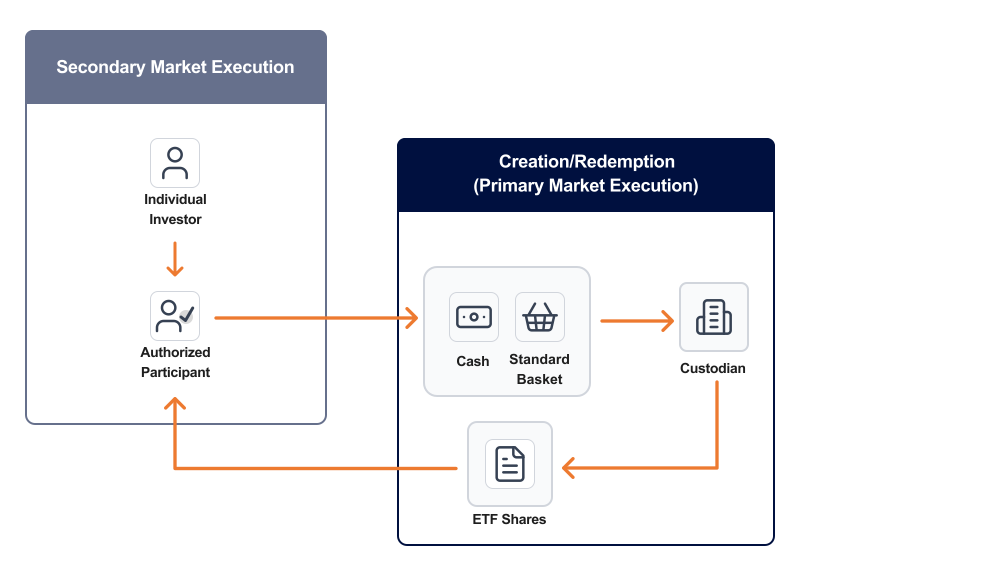
An investor buys ETF shares from the AP, the AP purchases the underlying delivery basket and sends the set of securities (plus cash) to the custodian. Then, the custodian creates new ETF shares and sends them to the AP.
Key Elements of ETF Operations: Operational Infrastructure
ETFs depend on advanced technology platforms that enable the delivery and settlement of their underlying portfolios. For U.S. domestic equity ETFs, infrastructure is well-established, while fixed income and international equity ETFs often rely on partnerships with major banks to access broader asset classes and global markets.
External Market Participants
ETF operations involve several specialized participants:
ETF Market Makers
These entities value, price, and quote ETFs on exchanges and alternative trading systems (ATS). Their primary responsibilities include ensuring regulatory compliance and maintaining business sustainability through revenue generation from trading activities.
Lead Market Makers (LMMs)
LMMs play the same role as an ETF Market Maker, while also supporting ETF issuers in developing and launching ETFs.
Authorized Participants (AP)
AP are legally empowered to create and redeem ETF shares. They possess the necessary operational infrastructure to manage the delivery and settlement of ETFs’ underlying assets.
Process Steps:
- The investor purchases ETF shares from the AP
- The AP purchases the underlying standard delivery basket of securities.
- The AP delivers these securities (and cash) to the custodian.
- The custodian creates ETF shares.
- The custodian delivers ETF shares to the AP.
- Redemption follows the reverse order.
This process enables market participants to create or redeem ETF shares on a daily basis, ensuring that ETF prices remain closely aligned with the value of the underlying securities.
Transparency and Arbitrage Boundaries
Fund Transparency
ETFs provide detailed insight into fund holdings and the “basket” of deliverable securities. This transparency enables market participants to effectively manage trading and risk. Daily holdings are presented via an investment manager’s website, as well as an industry-developed file system that utilizes the National Securities Clearing Corporation (NSCC) for secure data transmission and exchange.
Arbitrage Boundaries
These are the price limits that reflect the value of the underlying securities plus any operational costs. They help ensure that ETF prices do not deviate significantly from the fair valuation. If the price of an ETF rises above or below the current underlying portfolio’s fair valuation, APs can create or redeem new shares. This is the ETF that inherits the three core characteristics of the underlying portfolio: valuation, risk profile, and liquidity.
ETF Use Cases
ETFs can be utilized in various investment strategies:
Strategic Investment
ETFs offer core exposure across various asset classes for long-term investment allocations. Investors can utilize ETFs for a core investment allocation.
Tactical Investment
ETFs enable quick and efficient reallocation to manage short-term shifts in asset allocation, and can be paired with other similar investment exposures that have mandatory holding periods. ETFs allow investors to opportunistically adjust their risk exposure.
Cash Flow Management
ETFs trade intraday, allowing investors to manage cash flow requirements while maintaining strategic investment plans. Investors can buy or sell shares daily to help support the required cash flow requirements.
Portfolio Replication
ETFs come in a wide variety of investment strategies. An asset allocator can utilize a portfolio of ETFs to mimic the strategic holdings that have less flexible investment requirements or required holding periods. This assists asset allocators in managing cash flows across allocations.
Transition Management
ETFs serve as effective placeholders during transitions in overall investment exposures, thanks to their ease of trading and lack of required holding periods. The holding periods can last hours or span over months, as the investment manager decides on the new allocation or waits to deploy the funds.
Market Structure: Equity vs. Fixed Income
Equity Markets
Equities trade on centralized exchanges, supported by robust technology that connects various trading systems and regulatory pricing & execution mandates. This structure ensures full pricing transparency and easy access for all types of investors. With fewer than 5,000 listed securities, equity markets provide real-time, intraday pricing for every stock.
Fixed Income Markets:
In contrast, fixed income securities lack a centralized marketplace. Prices are independently projected by banks, broker-dealers, and electronic trading platforms, resulting in a fragmented market with inconsistent and opaque pricing. The fixed income universe comprises over 100,000 unique securities, but only a subset trades regularly, which limits both transparency and accessibility—even for sophisticated trading firms.
ETF Creation and Redemption Mechanisms
Equity ETFs
Equity-based ETFs allow authorized participants to deliver a predefined basket of securities in exchange for ETF shares. These baskets are straightforward to construct, as equities can be delivered in round or odd lot quantities, and index-based ETFs (like those tracking the S&P 500) have clearly defined components.
Fixed Income ETFs
Bond ETFs face delivery limitations, such as dollar minimums and lot sizes, and some bonds may not be available in the market. The creation/redemption process for fixed income ETFs is more flexible, involving negotiation between portfolio managers and authorized participants to source available bonds that best meet the fund’s investment objectives. Instead of replicating an entire portfolio, managers negotiate a subset of bonds that enhance the portfolio’s risk and return profile, allowing for tactical and strategic adjustments in response to market changes.
These ETFs play a crucial role in bringing transparency and efficiency to a fragmented market. By centralizing pricing and leveraging innovative valuation methods, these ETFs offer investors clearer insights and more reliable access to bond exposure than the underlying market itself. Their flexible creation and redemption process further enhances portfolio management, enabling strategic adaptation to changing market conditions.
Pricing Challenges and Solutions
Fragmentation as a Hurdle
The absence of a unified pricing source makes it difficult to determine fair values for many bonds. Market makers for fixed income ETFs address this challenge by aggregating prices from multiple sources, effectively acting as a centralized exchange for ETF investors.
Matrix Pricing
For bonds that do not trade frequently, market makers use matrix pricing that extrapolates values from actively traded securities to estimate prices for less liquid, similar bonds. This approach fills gaps in pricing and ensures ETF valuations reflect the broader market.
Dynamic Adjustments
As market conditions change – such as shifts in interest rates, credit spreads, or prepayment expectations – ETF market makers update their pricing models and portfolio compositions. This ongoing process ensures that ETF prices remain aligned with current market realities.
Centralized Transparency
By centralizing the pricing process and continuously adjusting for risk variables, fixed income ETFs provide investors with a transparent and accurate representation of bond market valuations—often more so than the underlying market itself.
Summary
ETFs are designed to deliver transparent valuation, risk alignment with underlying assets, and liquidity sourced from their portfolios. Their efficient creation and redemption processes, which are managed by authorized participants and supported by operational infrastructure, ensure adaptability and effective market functioning. Collaboration among market makers, APs, and custodians is essential for maintaining these core characteristics and delivering benefits such as transparency, efficiency, flexibility, liquidity, and cost effectiveness.
Discover more about:
Related Content

More Insights

What Investors Need to Know About Markets and Macro Now

2026 Fixed Income Outlook: Uncertainty is High, but the Margin for Error Isn’t

The Three-Basket Approach to Equity Portfolio Construction

An Active Investment Guide to Navigate the AI Hype

Fishing In A Profitable Pond